Original Insight
Navigating the GHG Protocol 2026 Scope 3 Updates
The GHG Protocol Guidance for Scope 3 emissions is moving decisively away from "best-effort" estimates toward a financial-grade, auditable system designed to align with global standards like the ISSB and CSRD. This evolution marks the end of selective disclosure where companies could claim conformance while excluding significant portions of their total value chain’s footprint.
The 4 Major Changes to Scope 3 Reporting in 2026
The GHG Protocol has proposed the following four fundamental changes to their Scope 3 Guidance in order to remain relevant in the constantly evolving sustainability reporting environment:
Category 16 - Beyond Physical Ownership
- Definition: A new category has been developed to account for other value chain activities not covered by Categories 1-15.
- The Shift: Moves Responsibility from physical ownership to systemic influence.
- Impact: Captures “facilitated emissions” in financial services and the digital economy.
The 95% Completeness Rule
- The Mandate: Companies must account for at least 95% of total relevant Scope 3 emissions to claim conformance.
- The Goal: Eliminates “cherry-picking” and selective disclosure of easy-to-measure categories.
Mandatory Data Disaggregation
- Requirement: Data must be presented by source type (Primary vs. Secondary).
- Strategic Value: Puts a spotlight on data quality. Companies relying heavily on secondary “spend-based” data will be laggards compared to those engaging directly with their supply chain.
Stock-Based Accounting (Annualized Emissions)
- The Change: Moving from “Lifetime Accounting” to an annualized stock-based model.
- Circular Economy Alignment: This rewards product durability. Instead of being punished for a product that lasts 20 years, companies report the actual annual emissions of the “active stock” in the field.
Let's break down what these changes mean for your company and how to turn compliance into a competitive advantage.
Business Implications of the 2026 Scope 3 Reporting Updates
Category 16: Other Value Chain Activities
You heard it right. The GHG Protocol has included a new category entirely. The introduction of Category 16 marks a fundamental shift in how the GHG Protocol defines a company’s responsibility, moving the goalposts from physical ownership to systemic influence.
A primary driver for this change was the need to bring clarity to the financial services sector. While Category 15 remains focused on financed emissions, where a bank provides direct capital through loans or equity, Category 16 now captures facilitated emissions from activities like insurance underwriting, M&A advisory, and the issuance of new shares. This ensures that when a bank or insurer uses its expertise to help a fossil fuel company raise capital or mitigate risk, that facilitation is visible in their climate disclosure.
This evolution also addresses the modern digital economy, specifically targeting platform companies and the crypto ecosystem. Under the new guidance, e-commerce marketplaces that facilitate transactions between third-party buyers and sellers, or crypto exchanges that enable the energy-intensive mining and trading of digital assets, must now consider these facilitated impacts.
It even extends to professional influence in sectors like architecture and engineering; if a firm designs a building with an inefficient carbon profile, those downstream impacts are increasingly viewed as facilitated by the designer.
The 95% Rule - Supply Chain Engagement and Audit Readiness
One of the current difficulties that have been noted in the Scope 3 reporting space is a lack of transparency about the full extent of companies’ Scope 3 profile. Companies often report only on a few specific Scope 3 categories indicating that the unreported ones are either immaterial or too difficult to measure. This leaves the remaining categories being assessed from a high level in the materiality process, allowing companies to manage the often highly resource intensive process and keep costs to a minimum. The lack of reporting and rationale to support it drives distrust in the final reported figures as it comes across as cherry-picking the best categories.
In order to combat this, the GHG Protocol’s proposal is to implement a mandatory 95% completeness threshold. Companies would be required to account for at least 95% of their total relevant Scope 3 emissions to claim conformance with the standard.
This effectively ends the era of selective disclosure. You will likely need to conduct a comprehensive "screening" of all 15 (now 16) categories with much higher rigor, even for those that previously seemed negligible. Is it going to be a lot more work? Will the costs and burden of future audits increase as they have to dive deeper and select more samples from more categories? Yes, but it also achieves the intended purpose that the GHG Protocol is looking for:
Providing your stakeholders with more transparency, and you with more insight and control over your entire value chain.
Mandatory Data Disaggregation
Scope 3 reporting has a hierarchy of data sources. Unlike Scope 2 where you have a meter that you can read your electricity usage off or receive an invoice from your service provider detailing the exact energy consumption for the month, Scope 3 data is outside of your own company’s direct control and the data is often difficult to obtain.
When primary data is not able to be obtained, emissions are estimated from the general ledger information. This is Spend-Based Data which entails a complicated process of categorising transactions in the general ledger based on their purpose (fuel and diesel supply, energy and power supply, auditing services etc.). From here, you are able to assign an emission factor to each category.
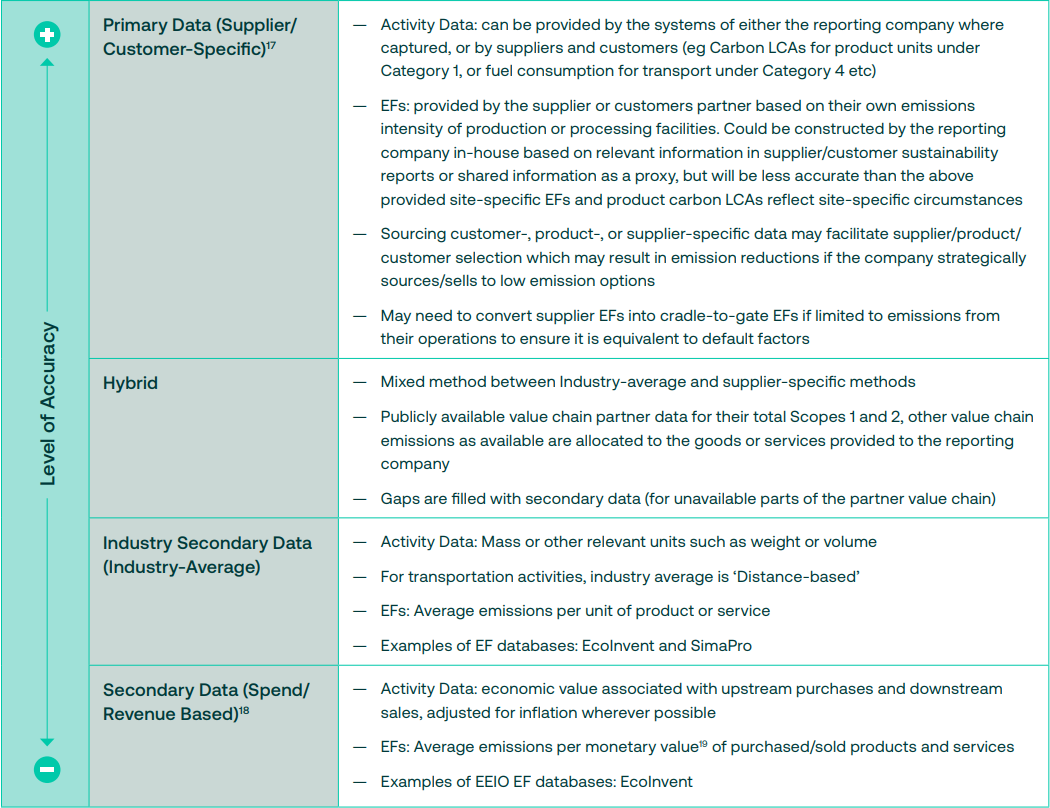 Data type hierarchy - Source: ICMM Scope 3 Emissions Accounting and Reporting Guidance.
The issue with this approach is that the accuracy is very low (lowest level of accuracy in the above figure). The emissions are based on averages which means that if you are receiving services from a supplier that makes use of renewable energy and has a low carbon footprint as a result, you could be overstating your Scope 3 emissions. With the current approach, there is no need to engage with your value chain. There is no need to validate the accuracy or completeness of the emissions provided. There is no need to vet suppliers based on their carbon footprint and its impact on you.
This was not the intended purpose of the GHG Protocol’s guidance and so, to correct the course of reporting and the low accuracy and completeness of the data that companies report, they have proposed to mandate disaggregated emissions reporting by Data Type, meaning that companies report their Scope 3 emissions based on Category and data type (e.g.,Category 6 Primary Data | Category 6 Secondary Data). This puts a direct spotlight on data quality.
A company with 90% Secondary Data will now look significantly less climate-mature than a peer with 50% Primary Data, even if their total footprints are similar.
While disaggregation still permits secondary data for compliance, maturing Scope 3 standards are driving a shift toward primary data. As secondary data is increasingly viewed as a mere "best estimate," companies face mounting pressure to source actual figures to stay competitive. This shift forces companies to conduct due diligence and engage directly with their supply chain. For suppliers, the stakes are high: failing to provide granular, evidence-backed emission data per sale now risks the loss of contracts and market share. Transparency has evolved from a reporting hurdle into a business necessity.
Stock-Based Accounting
Under the previous guidance, a manufacturer was required to report the amount of carbon a product would emit over its functional life the moment it left the factory. This meant that if a company engineered a washing machine to last twenty years instead of ten, their reported Scope 3 emissions would instantly double on paper, even though their durable design reduced waste and total consumption.
The proposed change to the reporting approach is to account for this information on a stock-based model. Instead of looking only at the 2026 sales figures, a company now accounts for the emissions generated by every unit currently in the field, regardless of when it was originally purchased. This methodology treats sold products similarly to how a company might treat its own physical assets, creating a steady, annual stream of data that aligns perfectly with financial reporting cycles.
By moving to an annualized stock-based model, the GHG Protocol has finally aligned carbon accounting with the goals of the circular economy.
The Scope 3 changes are rewarding companies that keep products in use longer rather than punishing them for it.
How do I know if my product is still being used? The guidance introduces rigorous tracking requirements. Companies must move away from simple sales estimates and toward active stock modeling, utilizing survival curves - statistical tools that estimate how many units are likely still running based on historical repair and retirement data.
For the more advanced firms, the protocol prioritizes primary IoT and telematics data, where a product is only included in the count if it is digitally "active". This shift ensures that the moment a machine breaks or is recycled, it is removed from the company's carbon ledger, providing a dynamic and auditable view of their true environmental footprint.
Scope 3 Decarbonization: 4 Real-World Case Studies
Although the road ahead for companies looks to be a difficult one, value is still able to be derived from this journey. Some companies have already been applying what these changes are trying to bring in and have managed to reap significant financial benefits as a result.
Circular Finance: Philips’ Transition to Stock-Based Accounting
- The Strategy: Shifted from GHG Category 11 "Lifetime Accounting" to a "Stock-Based" model, proving leased, refurbished medical equipment has a significantly lower annual footprint.
- The Outcome: Secured Sustainability-Linked Loans (SLLs), triggering lower interest rate coupons by successfully hitting specific circularity targets.
- The Impact: Generated €4.96 billion in circular revenue (27.9% of sales).
The 95% Rule: Apple’s Supply Chain Engagement
- The Strategy: Addressed Scope 3 Category 11 hotspots by removing chargers, which shrunk retail box volumes by 70% to reduce e-waste and optimize logistics.
- The Outcome: Fit 70% more units per shipping pallet, drastically reducing the required global flights and maritime transport emissions.
- The Impact: Estimated $6.5 billion in savings through logistics efficiency.
Material Efficiency: Unilever’s Packaging Redesign
- The Strategy: Leveraged Scope 3 data to re-engineer aerosol spray systems, delivering the exact same product volume in a can half the original size.
- The Outcome: Decreased raw aluminum usage by 25% per unit while increasing pallet density and logistics efficiency by 35%.
- The Impact: Millions saved in procurement while lowering Category 1 emissions.
Commodity Hedging: Schneider Electric’s Tiered Data Redesign
- The Strategy: Applied a "Tiered Data" approach to redesign EvoPacT industrial circuit breakers, shrinking the physical footprint of the units by 25%.
- The Outcome: Drastically reduced reliance on price-volatile, high-carbon commodities like copper and steel, cutting emissions and costs simultaneously.
- The Impact: Created a 25% hedge against inflation and enabled premium pricing.
Is Your Value Chain Ready for the New Standard?
The transition toward financial-grade Scope 3 reporting and the shift from estimates to auditable evidence is no longer a peripheral concern; it is a fundamental shift in how corporate longevity is measured.
Are you ready to engage with your entire value chain, from suppliers to customers, to ensure that your Scope 3 data is not just compliant but a strategic asset?
- Data Maturity: Are you still relying on spend-based estimates, or do you have a roadmap to increase primary data collection from Tier 1 and Tier 2 suppliers?
- Systemic Influence: If you operate in financial, digital, or design sectors, have you mapped your Category 16 facilitated emissions?
- Circular Logic: Can you prove the "active life" of your goods to benefit from durability-linked emission reductions?
- Audit Readiness: Can your infrastructure withstand a 95% completeness audit, or are there "blind spots" in your supply chain?
While Scope 3 represents the next frontier of complexity, achieving excellence in your direct footprint remains the foundation of any ESG strategy. The GHG Protocol team has been busy this year, to understand the new Scope 2 guidance and how to refine your internal energy reporting, moving beyond basic compliance, read our perspective on The New Scope 2 Guidance.
Click here to reach out to our strategy team to discuss your Scope 3 roadmap and see how we can transform your impact reporting into a powerful narrative for stakeholders.